
Akron Frozen Pipes
Dedicated Winter Water Damage Specialists
When a plumbing line fails during winter, dispatching our emergency water damage restoration specialists immediately stops structural deterioration.
The median owner-occupied home locally was built in 1954 according to Census ACS 5-year data, meaning older plumbing runs frequently lack modern thermal protection.
There are 93,215 housing units on record in the Census ACS 5-year estimates for the local building inventory.
About 5% of housing units in the local community (4,814 of 93,215) were built since 2000, so a substantial share of the local stock is still on its original systems.
Additionally, about 16% of housing units in the area (14,606 of 93,215) were built in the 1970s and 1980s, overlapping the years polybutylene supply piping was commonly installed.
Homeowners often describe how sub-freezing temperatures cause interior water pipes to rupture and flood finished living spaces, necessitating immediate water extraction and structural drying.
A pattern echoed in public discussions is that overnight frozen pipe breaks funnel water downward through ceiling cavities and subfloors, pooling into the basement and warping hardwood floors.
Our technicians isolate compromised plumbing sections and deploy commercial drying equipment to protect foundational framing across Summit County properties.
How We Resolve Frozen Pipe Emergencies
When sub-zero conditions hit northeast Ohio, plumbing runs freeze and split without warning. We follow a rapid four-stage mitigation protocol, including extracting water after severe basement flooding, to halt property destruction immediately.
- Immediate Water Isolation And Containment. Technicians locate the failure point, isolate supply lines, and shut off power to waterlogged circuits. Overhead plumbing leaks and burst lines are immediately depressurized to prevent progressive moisture spread across finished living spaces.
- Industrial Water Extraction And Demo. As homeowners frequently report in trade forums, overhead frozen pipe bursts saturate ceiling drywall and cause structural collapse, requiring rapid industrial dehumidification and material removal. High-volume truck-mount vacuums pull standing water from saturated carpeting, subfloors, and ceiling cavities.
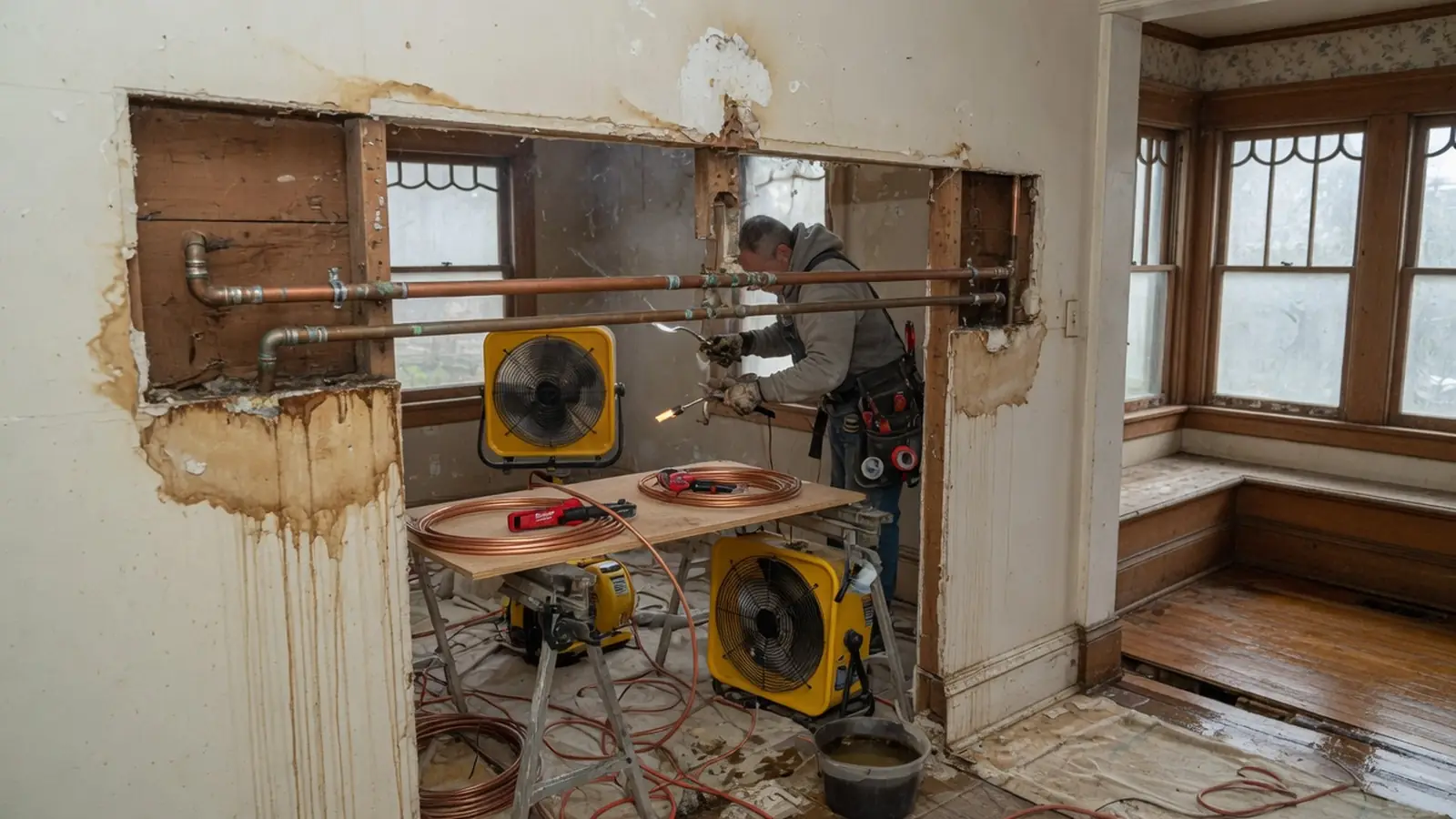
- Targeted Thermal Dehumidification. We position commercial LGR dehumidifiers and high-velocity air movers to force dense moisture out of structural framing. Heated drying air is channeled into wall cavities and joist spaces to evaporate trapped condensation rapidly.
- Cavity Moisture Monitoring And Verification. A reality highlighted in homeowner discussions is that thorough moisture monitoring in non-obvious framing and ceiling cavities is critical after a burst pipe to halt secondary damage and mold colonization. We record daily psychrometric readings across hidden wall cavities until wood framing reaches safe baseline equilibrium.
Our Structural Preservation Promise
Our mitigation standards require continuous thermal imaging and invasive moisture checks behind baseboards and joists. Thorough moisture monitoring in non-obvious framing and ceiling cavities is critical after a burst pipe to halt secondary damage and mold colonization. We follow an IICRC-aligned protocol for comprehensive mold remediation and structural stabilization to ensure your property is completely sanitized and certified dry.
Ceiling Collapse And Drywall Removal
Overhead frozen pipe bursts saturate ceiling drywall and cause structural collapse, requiring rapid industrial dehumidification and material removal. We quickly take down waterlogged drywall, bag soaked fiberglass insulation, and establish negative air barriers to keep contaminants from traveling into adjoining living areas.
Emergency Subfloor Water Extraction
Overnight frozen pipe breaks funnel water downward through ceiling cavities and subfloors, pooling into the basement and warping hardwood floors. We deploy heavy-duty floor drying injection systems that pull trapped moisture directly through tongue-and-groove boards without unnecessary tear-outs.
Crawl Space Pipe Burst Restoration
Supply lines routed through cold exterior foundation walls and perimeter crawl spaces are prone to major freeze splits during cold snaps. Our crews enter confined crawl spaces to pump out standing pools, replace contaminated vapor barriers, and dry structural sills thoroughly.
Our Dedication To Restoring Freeze Damage
Freeze events demand immediate tactical intervention with industrial equipment and disciplined moisture logging. We deploy commercial desiccant systems, infrared cameras, and precision meters to return properties to safe, verifiable dry standards.
- 17Zip Codes Served
- 6Service Areas
- 3Services Offered
Read genuine feedback from property owners who experienced catastrophic pipe freezes and relied on our rapid extraction and drying services.
“Every single morning started with a detailed text message and photos of the drying logs while we were staying at a hotel. The crew answered every question before we even thought to ask it, so we never had to chase anyone down. Their clear updates gave us complete peace of mind through a chaotic week.”
Marcus T.
“Rather than pushing for expensive full cabinet tear-outs, the lead specialist showed us how targeted drying mats could save our original maple vanities. The crew explained the thermal differences between insulation types, which trimmed hundreds off our final repair bill while keeping the crawl space far warmer. That transparent advice was invaluable.”
Brenda K.
“A brutal lake effect blizzard closed our access hill on the second afternoon, but the technicians rerouted through a lower access trail to keep the dehumidifiers running. They worked late into the evening to recover lost time and kept the structural drying completely on schedule. You rarely find that level of commitment during severe winter storms.”
Darren S.
“Our condo association has strict rules regarding shared utility corridors and exterior equipment noise. The crew spoke directly with the property manager to coordinate intake hoses and positioned whisper-quiet air movers that did not disturb the adjoining townhouse. Their professionalism prevented any neighborhood friction entirely.”
Elena V.
Frequently Asked Questions
What should I do first when an interior pipe bursts from freezing?
Shut off your main water valve immediately to stop flooding, then turn off electricity to wet rooms before calling a certified mitigation crew. Locate the primary shutoff near your water meter or basement entry point. Opening unaffected faucets can relieve residual line pressure while you await emergency extraction.
How long does structural drying take after a burst pipe?
Industrial drying typically requires three to five days of continuous dehumidification and air movement to reach certified dry standards. Dense materials like subflooring, wall studs, and hardwood flooring require sustained moisture extraction and daily psychrometric monitoring to prevent secondary mold growth.
Does homeowners insurance cover frozen pipe damage and cleanup?
Most standard policies cover sudden and accidental freeze damage, provided the property maintained reasonable heat leading up to the freeze. We provide full digital moisture logs, thermal imaging captures, and line-item documentation to support your claim directly with your insurance adjuster.
Why are older homes more vulnerable to frozen pipe bursts?
Older residences often feature uninsulated perimeter crawl spaces and supply lines run directly along exterior framing without thermal breaks. Vintage building layouts frequently route plumbing through drafty overhangs or exterior walls without adequate insulation, leaving them exposed during severe cold snaps.
Can I thaw a frozen water pipe myself with an open flame torch?
Never use an open flame torch to thaw pipes because it creates an extreme fire risk and can cause trapped steam to burst the copper line. Safe thawing methods involve controlled heated air, electric heat tape, or warm towels, alongside gentle shutoff monitoring to catch active leaks immediately.