
Akron Basement Flooding
Basement Water Extraction And Structural Drying
Prolonged rainfall saturates local clay soil and overwhelms exterior perimeter drains, leading to widespread basement flooding across older neighborhoods like Firestone Park.
As severe hydrostatic pressure during downpours forces water to seep continuously through porous concrete masonry walls, foundation stability quickly becomes compromised.
A pattern echoed in public discussions is how prolonged rainfall saturates local clay soil and overwhelms exterior perimeter drains, leading to widespread basement flooding that catches property owners unprepared.
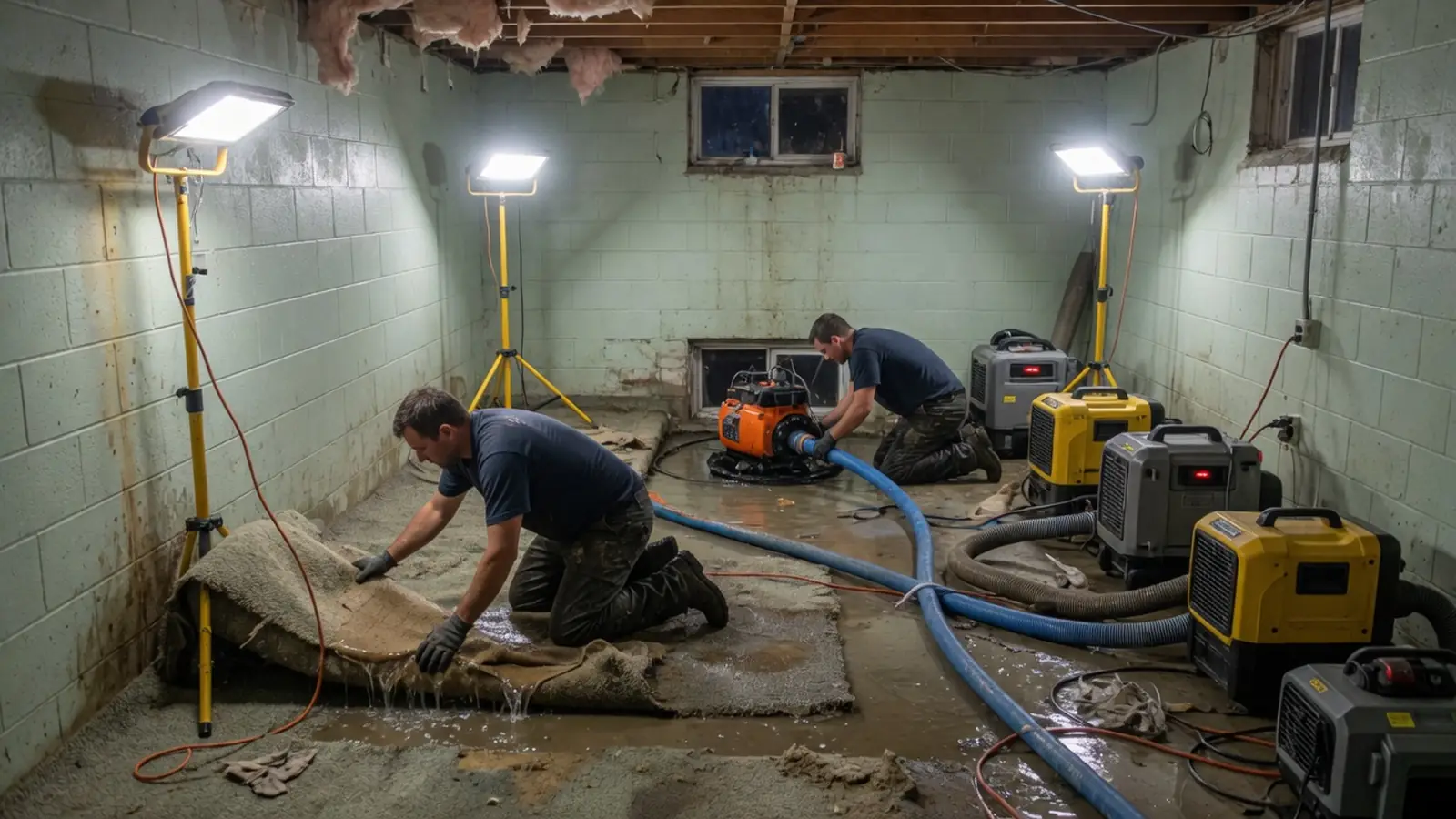
Our technicians inspect subsurface footers, measure subfloor moisture saturation, and deploy industrial extractors immediately.
When unexpected subfloor saturation threatens your property, find out more about our emergency water damage restoration services designed for rapid structural recovery.
We extract pooled water, sanitize surfaces, and run thermal air movers until every structural stud reads at safe moisture levels.
Our Flooded Basement Restoration Protocol
Homeowners often describe how mechanical sump pump breakdown during storms leaves significant standing water across basement floors requiring emergency pump replacement, making rapid response vital.
- Emergency Extraction And Pumping. Mechanical sump pump breakdown during storms leaves significant standing water across basement floors requiring emergency pump replacement. Our crew pumps out standing water rapidly using truck-mounted extraction equipment to prevent structural settling.
- Decontamination And Drain Clearing. When heavy flash storms overburden city storm lines, pushing water and raw sewage backward through basement floor drains, strict biological containment is necessary. We remove hazardous blackwater contaminants, sanitize the concrete slab, and wash the drainage channels with hospital-grade biocides.
- Material Removal And Antimicrobial Treatment. Removing flood-damaged drywall exposes hidden mold colonization across wall framing studs that requires professional antimicrobial sanitization. If subfloor moisture lingers, you can explore our professional mold remediation process to safeguard structural timbers and indoor air.
- Structural Drying And Moisture Monitoring. Because water actively seeps through cracked concrete foundation blocks during wet conditions, prompting concerns over structural intrusion, thorough drying is critical. We install commercial dehumidifiers and LGR air movers, checking wall and floor moisture with digital hygrometers until dry.
Our Workmanship Standard
A frequent observation in local homeowner discussions is that severe hydrostatic pressure during downpours forces water to seep continuously through porous concrete masonry walls. Visible black mold growth colonizes damp foundation corners in unfinished basements, raising health and air quality concerns when water intrusion is ignored. During harsh winter freezes, see how we repair burst and frozen pipes before water inundates lower levels. We follow strict remediation protocols using EPA-registered antimicrobials and commercial desiccant dehumidifiers to guarantee thorough structural moisture elimination.
Sump Pump Emergency Extraction
When torrential rainstorms overwhelm residential sump pumps, leaving standing water pooling in corners and backing up basement stormwater lines, our technicians extract the water immediately. We deploy submersible pumps and industrial vacuums to clear basements before moisture wicks into upper framing.
Storm Line & Drain Backup Cleanup
Heavy flash storms overburden city storm lines, pushing water and raw sewage backward through basement floor drains. We extract contaminated water, remove unsalvageable porous items, and thoroughly disinfect concrete surfaces to restore sanitary conditions.
Foundation Seepage & Mold Sanitization
Visible black mold growth colonizes damp foundation corners in unfinished basements, raising health and air quality concerns. We treat affected framing and masonry with antimicrobial biocides while drying out concrete blocks with high-capacity dehumidifiers.
Dedicated Flooded Basement Restoration
Basement flooding requires immediate attention and systematic structural drying. We focus on rapid water removal, moisture mapping, and thorough sanitation to return your property to a safe condition without unnecessary delay.
- 15Zip Codes Served
- 6Service Areas
- 3Services Offered
Local property owners rely on our emergency response when rising water threatens their homes. Here is what customers say about working with our mitigation specialists.
“Our basement flooded on a Sunday night after our sump pump stopped running during a massive downpour. The crew answered our call immediately and had an extraction unit at our door within the hour to start pumping out the water. Their rapid response kept the flooding from spreading into our finished utility room.”
Marcus B.
“Every evening before heading out, the crew swept up debris, stacked their air movers neatly, and hauled away the waterlogged carpet scraps. They made sure all cords were taped down safely so we could still access our laundry area. It was refreshing to see such respect for our living space throughout the drying process.”
Elena R.
“We received detailed photo updates and moisture meter readings by text message twice a day while we were stuck at work. The team explained exactly how much moisture was left in the foundation blocks so we never had to wonder what was happening. Their proactive communication took a huge amount of stress off our shoulders.”
Derek T.
“Instead of tearing out all the perimeter baseboard framing, the crew explained how targeted bottom cuts and antimicrobial wash would salvage our solid wood studs. That practical advice saved us thousands of dollars in structural repairs while still eliminating any risk of mildew. They focused on what was actually necessary rather than trying to pad the restoration scope.”
Sonia K.
Frequently Asked Questions
How quickly should standing water be removed from a flooded basement?
Standing water must be pumped out within 24 to 48 hours to prevent severe structural wood rot and dangerous microbial colonization. Prompt extraction halts moisture penetration into foundation concrete blocks and stops mold from taking hold on drywall framing.
What causes basement flooding after heavy rainstorms in Summit County?
Heavy rainfall saturates dense clay soil and overpowers foundation drainage, pushing ground moisture through porous concrete walls. Torrential downpours also overwhelm residential sump pumps, which can lead to backflow through floor drains.
Does homeowner insurance cover basement flooding restoration?
Standard home policies typically cover sudden burst interior pipes but require specific riders for ground seepage and sump failures. We provide comprehensive photographic evidence and moisture mapping logs to streamline claim processing with your insurance adjuster.
How long does the complete basement drying process usually take?
Complete structural basement drying generally takes between three to five days using professional dehumidifiers and air movers. Thick concrete block foundations may take slightly longer to release deep moisture under high seasonal humidity.
Can wet drywall and framing studs be saved after a basement flood?
Drywall soaked with contaminated floodwater must be cut out, whereas solid framing lumber can typically be sanitized and dried in place. We perform flood cuts several inches above the water line, exposing wall cavities for complete antimicrobial sanitization.