
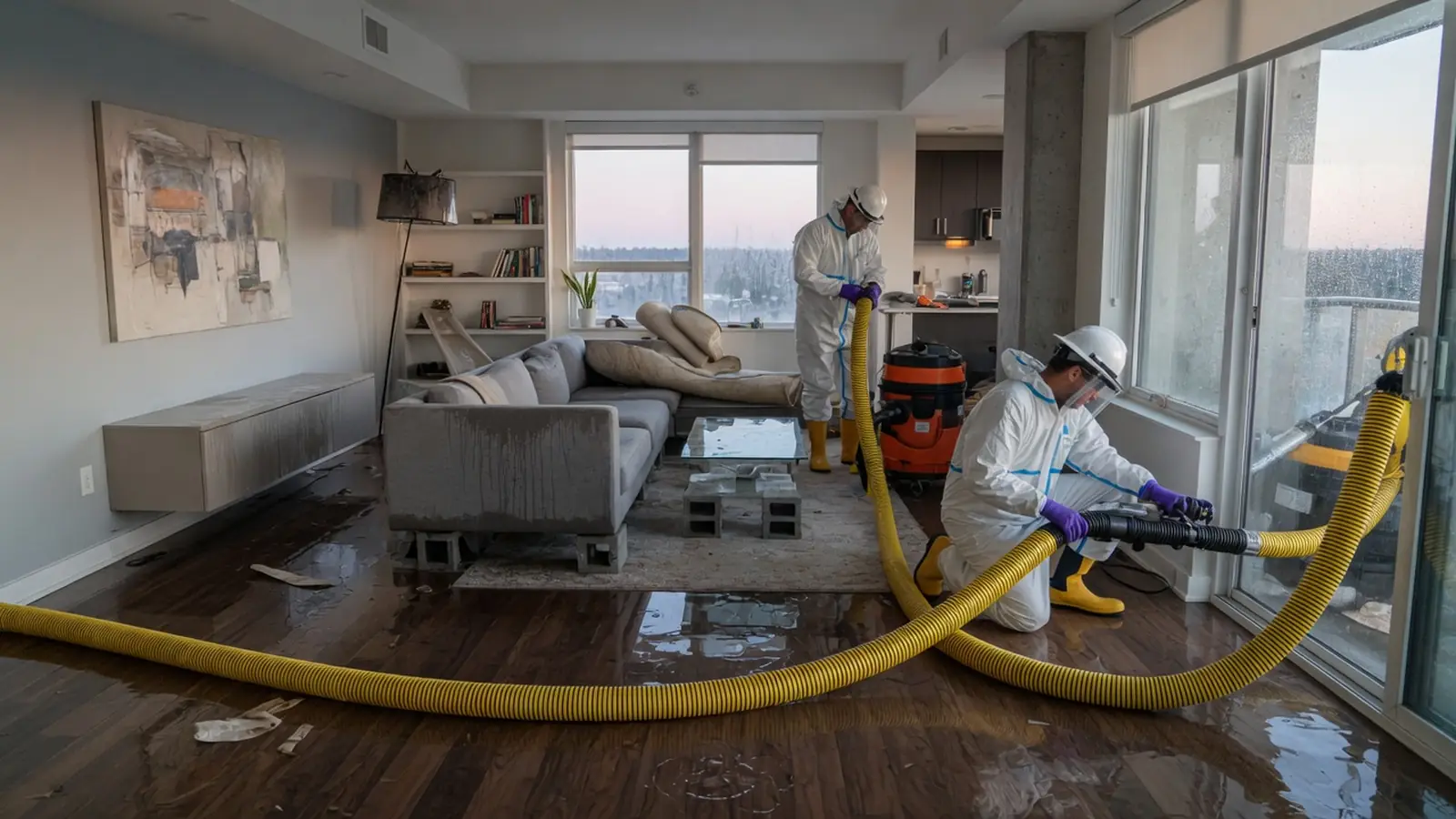
Emergency Water Damage Restoration Akron OH
Dedicated Emergency Restoration
Our emergency restoration crew brings years of hands-on structural drying experience to local property owners facing sudden plumbing failures and severe groundwater intrusion.
About 62% of housing units in this area (57,338 of 93,215) were built before 1960, the era of galvanized steel supply lines and cast iron drains prone to corrosion.
About 13% of housing units across the community (11,715 of 93,215) were built in the 1960s, overlapping the years aluminium branch wiring was installed.
About 16% of housing units in the local jurisdiction (14,606 of 93,215) were built in the 1970s and 1980s, overlapping the years polybutylene supply piping was commonly installed.
The single most extensive soil unit mapped around our service territory is Canfield silt loam, 2 to 6 percent slopes, covering about 18,478 acres of OH153 and creating slow subsurface drainage.
A pattern echoed in public discussions is that heavy flash storms overburden city storm lines, pushing water and raw sewage backward through basement floor drains.
When backflow or foundation seepage threatens your subfloors, our technicians step in to resolve recurring basement flooding issues before rot sets in.
Every project concludes with rigorous thermal imaging and moisture metering to guarantee complete cavity dryness before any reconstruction begins.
Our Step-by-Step Restoration Protocol
Because the dominant mapped soils in this territory (OH153) by acreage are Canfield silt loam, 2 to 6 percent slopes; Mahoning silt loam, 2 to 6 percent slopes; Chili-Urban land complex, undulating; Ellsworth silt loam, 2 to 6 percent slopes, dense ground conditions cause surface runoff to pool against foundations. Our systematic four-step mitigation process addresses structural water ingress from the roofline down to the basement slab.
- Immediate Emergency Containment. Practitioners emphasize that upper-floor pipe breaks cascade across multiple levels, requiring immediate structural containment to prevent widespread building damage. Our crew isolates the water source, sets containment barriers, and begins high-volume water extraction immediately.
- Sustained Moisture Extraction And Plumbing Repair. When winter cold snaps compromise uninsulated plumbing, homeowners need fast emergency response for burst frozen pipes. We extract pooled water from subfloors, remove standing moisture, and deploy moisture probes to map saturation behind baseboards.
- Targeted Controlled Demolition And Dehumidification. As highlighted in restoration trade guides, removing saturated ceiling drywall alongside industrial air movers and dehumidifiers allows full structural dryout within a standard 3-day window. We extract wet insulation, position centrifugal air movers, and pull gallons of moisture from the ambient air daily.
- Structural Verification And Antimicrobial Sanitization. Homeowners often describe uncertainty over whether concrete slabs and framing retain trapped moisture after flood remediation, risking recurrent mold prior to rebuilding. We apply hospital-grade antimicrobial treatments and use calibrated pinless meters to confirm all studs and concrete achieve baseline dry standards.
Our Restoration Commitment
About 90% of housing units across this municipal region (83,659 of 93,215) were built before 1980, the period when asbestos-containing materials and lead paint were still in use, requiring containment safety during flood cutouts. Our certified technicians follow strict ANSI/IICRC S500 water damage restoration standards, prioritizing non-destructive structural drying whenever viable. We safeguard property value and indoor air quality by preventing structural decay through professional mold remediation while standing behind every drying project with documented daily moisture logs.
Basement Water Extraction
Rapid removal of standing floodwater and subfloor moisture using high-volume submersible pumps and industrial extraction units. We stabilize structural framing quickly to halt secondary wood rot.
Burst Pipe Structural Drying
Targeted drying for multi-level plumbing failures, wall cavities, and soaked subfloors. Industrial air movers and commercial dehumidifiers pull hidden moisture from enclosed building assemblies.
Complete Moisture Remediation
Thorough structural decontamination and anti-microbial treatments to safeguard indoor air quality. We monitor relative humidity and structural framing daily until dry standards are achieved.
Committed To Rapid Structural Drying And Restoration
Our dedicated response technicians prioritize moisture containment, certified extraction protocols, and honest communication from the initial call until your property reaches safe equilibrium moisture content.
- 15Zip Codes Served
- 8Service Areas
- 3Services Offered
Local property owners rely on our certified technicians during sudden water catastrophes. Here is how homeowners describe the diligence, clear communication, and dependable craftsmanship delivered by the crew.
“When our downstairs laundry room flooded, the crew showed us why replacing our ruined floor with closed-cell insulation and waterproof vinyl planking would prevent future rot rather than reinstalling standard composite. That practical recommendation saved us thousands on future repairs while keeping our restoration within insurance coverage. Their sensible guidance gave us genuine confidence during a chaotic week.”
Darren M.
“A severe ice storm knocked down power lines along our street, blocking equipment access right when our burst pipe remediation was starting. The team quickly adapted by staging generator power and rerouting drying lines through the rear walkout so our subfloor never lost crucial drying momentum. They still wrapped up the entire structural dryout right on schedule.”
Elena V.
“Our shared driveway setup created immediate friction with the adjoining townhouse owner over service van parking and industrial discharge routing. The crew stepped outside immediately, explained the drainage path courteously, and placed protective hose ramps so nobody was blocked or inconvenienced. That respectful attitude kept our neighborhood peace completely intact during a stressful cleanup.”
Marcus T.
“Six months have passed since water poured through our second-story ceiling, and our living space looks and smells completely untouched by moisture. There has been zero drywall sagging, no lingering mustiness, and the baseline moisture readings remain totally dry. Choosing this company for the remediation was easily the best decision we made for our home.”
Gretchen S.
Frequently Asked Questions
Do I need to cut out the bottom of my finished basement drywall if the floodwater was only two inches deep and has already receded?
Yes, drywall wicks moisture upward rapidly, requiring a flood cut at least twelve inches above the water line to prevent hidden mold growth.
Should I turn off the main water shutoff valve immediately if a faucet stops flowing during a hard freeze, or can I try thawing it with a space heater?
You should shut off the main water valve immediately to prevent severe flooding when cracked pipes thaw, rather than attempting open heating.
How long does professional emergency water damage restoration typically take?
Standard structural dryout requires three to five days of continuous commercial dehumidification and air movement to achieve safe standards.
Does homeowner insurance cover emergency water damage and drying services?
Most standard policies cover sudden, accidental water discharges such as burst pipes, but typically exclude exterior surface floodwater intrusion.
How do technicians verify that framing and concrete slabs are completely dry?
Technicians utilize calibrated pinless moisture meters and infrared thermal imaging to verify materials match pre-loss equilibrium standards.